


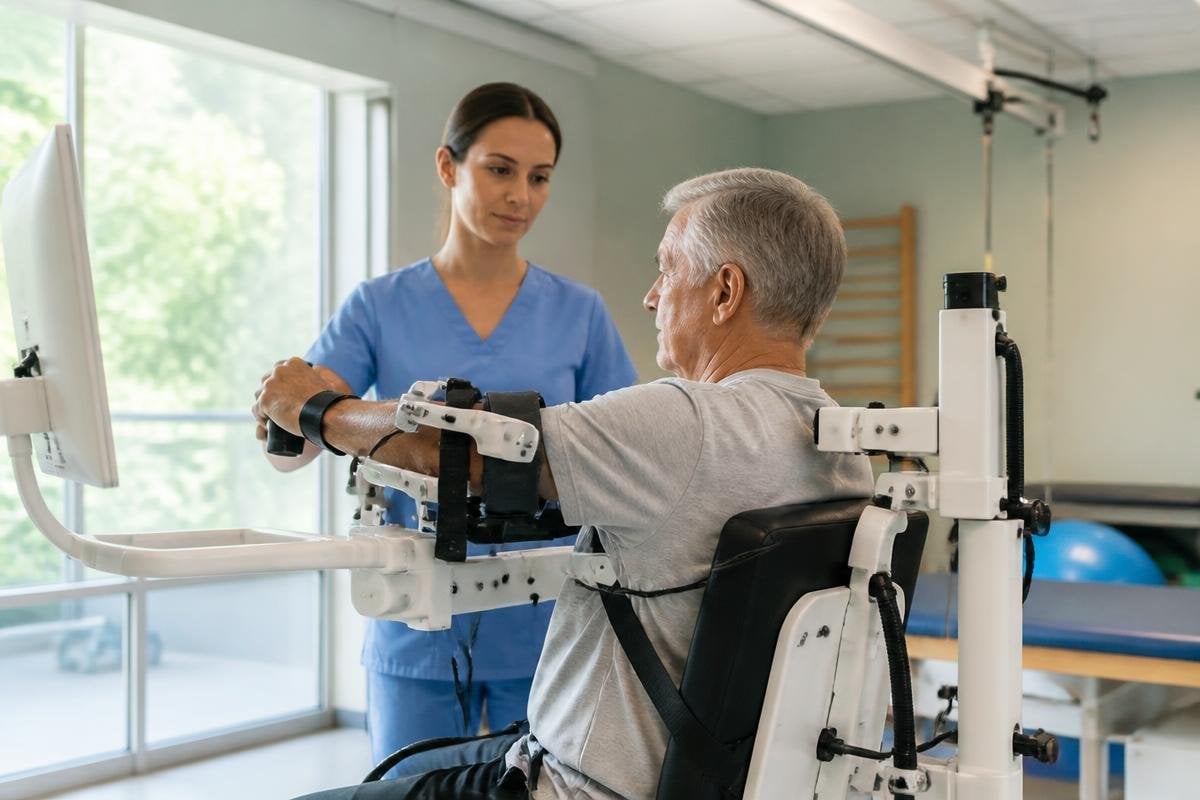
Rehabilitation robots guide repeated movements after an injury, surgery, or stroke. These systems support a patient’s arm or leg, measure movement, and adjust the task as strength returns.
Quick read
- Repeated practice gives the nervous system more chances to relearn a movement.
- Sensors record force, position, speed, and range of motion during each session.
- A therapist still chooses the task, checks the patient, and changes the treatment plan.
What the robot does during therapy
A rehabilitation robot usually supports part of the body while the patient tries to move. The system may guide the limb along a set path, add resistance, or reduce the load when the movement becomes difficult.
That support lets a patient practice a task for longer without carrying the full weight of the arm or leg. The goal is active effort from the patient, with the robot giving only the support needed for the task.
The machine can also repeat the same motion at a steady speed. This matters because recovery often depends on many controlled repetitions, and a therapist cannot physically guide every movement for an entire session.
How repetition can support recovery
After a stroke or spinal injury, the brain and body may need to rebuild links between an instruction and a movement. Reaching, stepping, standing, or gripping gives the patient repeated practice with that link.
A robot can make the task easier at the start. As the patient gains control, the therapist can lower the support or add resistance. The work then shifts toward the patient instead of the machine.
This gradual change also gives the therapist a clearer record of progress. A session can show how far the limb moved, how much force the patient used, and where the motion stopped. Those measurements help the therapist decide what to change next.
The main types of rehabilitation robots
Arm robots support reaching and hand movement. Some use a handle or brace, while others connect to the arm at more than one point. The robot can guide a patient through tasks such as lifting the hand toward a target.
Leg and walking robots support the hips, knees, or feet during standing and stepping. A treadmill system may carry part of the patient’s weight while the robot helps set the timing of each step.
Wearable systems use powered joints or braces attached to the body. Powered joints or braces can add force at the hip or knee, but fit matters. A poorly adjusted brace can change the movement the therapist is trying to train.
Fit also sets the limit for robotic arms and walking systems. These machines guide repeated motions while a therapist watches balance and force. A dated report on Robot24.com can put the machine, clinic, task, and measured result beside the claim before the next section looks at where these systems fall short.
Where the limits are
A robot can measure a joint angle or the force at a handle. It cannot decide whether a patient is tired, afraid, or using a movement that looks correct but causes pain. The therapist still needs to watch the whole person.
The machine also works best when the task matches the patient’s condition. A fixed movement may help one person and frustrate another. Treatment needs to change as balance, strength, pain, and attention change.
Cost, staff training, room space, and maintenance can also affect access. A clinic needs time to fit the patient, set the task, clean contact parts, and check the system before the next session.
The strongest case for these machines is repeated, measured practice under clinical supervision. They are less useful when a clinic cannot give patients enough therapist time or when the task has no clear link to daily movement.
Questions to settle before treatment
Use this checklist with the care team before a clinic starts robot-assisted therapy:
- Treatment goal: Which movement should improve, and how will the team measure it?
- Patient effort: How much of the task must the patient do without robot support?
- Safety checks: What stops the session if pain, weakness, or loss of balance appears?
- Fit and comfort: Which brace, harness, or handle touches the body, and who adjusts it?
- Progress plan: When will the team lower support or change the task?
I’d choose a program that explains the task and its measurement before showing the machine. The useful question is whether the patient gains better movement, not whether the robot looks advanced.
A rehabilitation robot earns its place when it gives a patient more safe practice and gives the therapist better information for the next session.
